
Writing on the Czech Exam — Form, Email & Essays
7 min read

On the A2 exam you write a form with three open questions plus a short email (at least 35 words); on the B1 exam you write two longer texts on a given topic — an email and a discussion-forum post — totaling at least 175 words. Both parts are scored against specific criteria (task completion, vocabulary, grammar) and have a fixed time limit.
This article breaks down what you'll actually find in the writing section — based on real practice tasks from this site — and how to organize your time and text structure so you can finish both tasks well.
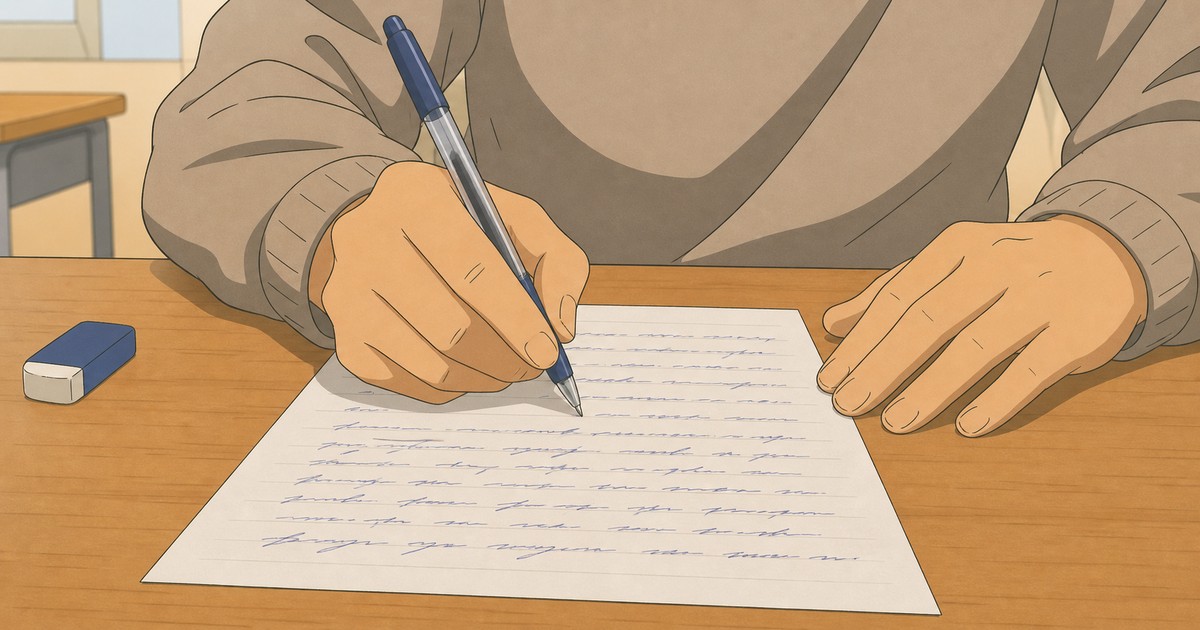
Writing on the A2 exam (permanent residency)
You have 25 minutes for writing, and the section is worth 20 points across two tasks. Writing points aren't tallied on their own — they fall into a combined written-skills gate together with reading and listening (you need at least 60% of 70 points combined); more in the article on the structure of both exams.
Task 1 — Form (8 points, 30–60 words)
Typical prompt: you're signing up for a course or event and must answer three open questions in full sentences, for example Why do you want to learn Czech?, Where and how long have you been living in the Czech Republic?, What do you like to do in your free time? Each answer must be at least 10 words — one-word or incomplete answers don't count.
Task 2 — Email (12 points, at least 35 words)
You write an email to a friend based on a prompt accompanied by five pictures — you must respond to each one with at least one sentence. Typical prompt: you're inviting a friend to a birthday party, and for the five pictures (a cake, a calendar, a clock, a house, an envelope) you write in turn that it's your birthday and you're inviting them, when the party will be, what time, where it's happening, and you ask for a reply. A text shorter than 35 words scores zero points — pay special attention to the minimum length.
Writing on the B1 exam (citizenship)
You have 60 minutes for writing, and the section is worth 25 points. Unlike A2, writing here usually consists of two longer free-form essays on a given topic, not a form.
Task A — personal email (12 points, 75–120 words)
Typical prompt: you've recently moved into a new apartment in a different city and you write an email to a friend inviting them to visit. The prompt asks about three specific things you must address — e.g. where and how you're living now, what you like most about your new home, and when and why they should come visit.
Task B — discussion post / opinion (13 points, 100–180 words)
Typical prompt: write a post for an online discussion forum, or a continuous text, expressing your opinion on a common social topic — e.g. working from home (its advantages and disadvantages, whether you'd want to work that way yourself and why). A coherent text with your own opinion and arguments is expected, not just a list of points.
You write both texts in full sentences, not bullet points — coherence and flow are also scored, not just whether you covered the required points.
Watch the pass threshold: for B1 the general rule is 60% overall and 60% in each subsection, but one of the written parts may follow a slightly different mechanism — please verify the exact rules on the current ÚJOP UK page, as they're occasionally updated.
How the text is graded by AI (and what the real exam grades too)
Both levels assess the same four areas used by the real exam:
- Task completion — did you address every point in the prompt (at A2, every picture too)?
- Vocabulary — is it varied enough and appropriate to the topic?
- Grammatical accuracy — subject-verb agreement, cases, word order, past/future tense used correctly in context.
- Length and formal requirements — did you meet the minimum (and, at B1, maximum) word count and the required text form (email vs. discussion post)?
Formal vs. informal Czech — which to choose
Both exam levels typically ask you to write to a friend — so use informal address and "tykání" (the informal "you"), not "vykání" (the formal "you"). A few practical differences:
| Situation | Informal (friend) | Formal (office, stranger) |
|---|---|---|
| Salutation | Ahoj Tomáši, | Vážený pane / Vážená paní, |
| Ty/vy | ty, tvůj | Vy, Váš (capital V) |
| Sign-off | Měj se, Ahoj, Zatím | S pozdravem |
| Sentence style | shorter, more colloquial expressions | longer, more formal/literary expressions |
If the prompt doesn't explicitly ask for a formal letter (e.g. a complaint to an office), stick with an informal email to a friend — that's the most common task type at both levels.
Useful phrases for both levels
- Email opening: Ahoj [name], jak se máš? Chtěl/a bych ti napsat, že…
- Transitioning between ideas: Kromě toho…, Navíc…, Na druhou stranu…
- Expressing an opinion (B1): Podle mého názoru…, Myslím si, že…, Osobně bych řekl/a, že…
- Giving a reason: …, protože…; Důvodem je, že…
- Invitation: Byl/a bych moc rád/a, kdybys přijel/a…, Těším se, až tě uvidím.
- Email closing: Napiš mi, jestli přijedeš. Měj se hezky, [name]
Common mistakes worth avoiding
- A text shorter than the required minimum word count. For the A2 email this means zero points outright — always count your words before submitting.
- Skipping one of the prompt's points — especially in the A2 email, where you need to respond to all five pictures; a missed point lowers the task-completion score even if the rest of the text is linguistically flawless.
- Mixing "tykání" and "vykání" in one text — pick one and stick to it from the greeting to the sign-off.
- Bullet points instead of connected sentences — for the B1 discussion post, flow and cohesion are scored too, not just individual pieces of information.
- Unchecked spelling and agreement — especially adjective/verb agreement in gender and number (e.g. byla jsem, not byl jsem, if you're writing as a woman) and correct i/y spelling after hard and soft consonants.
How to organize your time
- A2 (25 minutes for both tasks): budget about 8–10 minutes for the form (3 short answers) and the rest for the email — for the email, first jot down in four short points what you'll say about each picture so you don't forget anything.
- B1 (60 minutes for both tasks): handle the shorter Task A (75–120 words) in about 20–25 minutes, and the longer Task B (100–180 words) in the remaining time. For both tasks, leave a few minutes at the end to check your work — count the words, check agreement, and catch typos.
- In both cases: first sketch out the main points of your answer mentally (or on scratch paper, if you have time), then write the final version — it saves time on corrections.
Where to practice writing with AI grading
The best way to prepare for writing is to try real task types and get concrete feedback. On this site you'll find:
- Sample writing tests in the exam format — forms, emails and essays exactly matching the A2 and B1 structure.
- Writing practice with AI grading — standalone exercises for emails, letters and essays with instant feedback on grammar, vocabulary and task completion.
- If you're not sure about the overall exam structure, read what the Czech A2 and B1 exam looks like or how to prepare for the exam step by step.
Exact prompts, point thresholds and task formats may vary slightly between exam sessions. Always verify current conditions before the exam on cestina-pro-cizince.cz (A2) and ÚJOP UK (B1). This text is not legal advice.